The Mat Is Your Dojo's Safety Floor and Biggest Single Investment
A dojo's flooring shapes first impressions and parent trust - and, more critically, training safety. Substandard mats can cause serious injuries in falling and rolling drills. This guide gives owners a full decision framework from material and density to installation.
MOOTO delivers end-to-end flooring services from measurement to design to installation guidance. This article is the knowledge primer - understand first, then decide.
Core spec: training-grade mats need density of at least 150kg/m³; competition grade 200kg/m³+. Density drives rebound and lifespan - it is the last spec to compromise on.
Roll vs Puzzle Mats: Six-Dimension Comparison
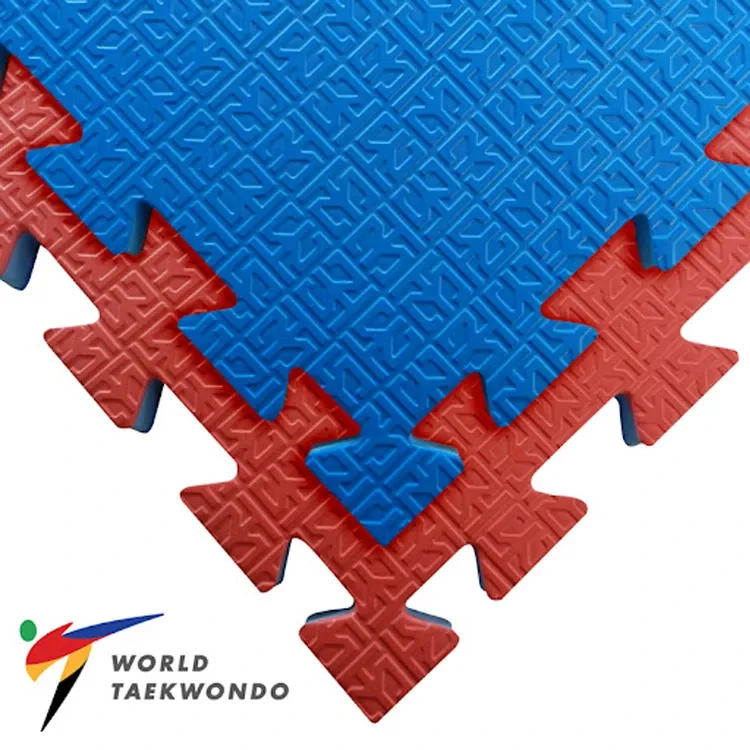
Roll mats lay in full sheets with seamless surfaces - ideal for competition dojangs and event venues. Puzzle mats install modularly, easy to relocate and replace section by section - ideal for multi-purpose gyms and flexible layouts.
Thickness & Surface: Match Your Training Type
3cm suits poomsae, footwork and light sparring; 4-5cm suits falls and high-intensity combat. For surface, PU leather resists wear for high-frequency use; PVC texture grips well for barefoot training. Kids classes should add a soft buffer layer.
"The mat is not a cost - it is your dojo's best insurance, protecting your students and your reputation every day."
Four Steps Before Installation
Step 1: measure the floor, noting columns, corners and skirting. Step 2: set density and thickness by training type and produce a layout plan. Step 3: calculate quantity with 5-8% allowance for odd shapes. Step 4: confirm budget and lead time. The MOOTO facility customizer accepts your floor dimensions directly for a plan and quote.
Four installation essentials: the floor must be flat and dry, seams must interlock offset, edges need trim strips, and large venues should be sectioned for future maintenance. Professional installers offer at least one year of seam warranty.
Budget Example
For a 12m x 10m multi-purpose training area with 4cm thickness at 200kg/m³: the puzzle-mat plan needs about 120sqm of matting plus trim and freight; the roll-mat plan offers flatter surfaces with slightly higher transport and install cost. Actual quotes vary with density, thickness and surface - send us your requirements and MOOTO replies with an itemized quote within one business day.
MOOTO PUZZLE MATS
MOOTO splicing mat (excluding tax and logistics transportation costs)
journal.faq
Q1.What density is right for training mats?+
150-180kg/m³ for general training; 200kg/m³+ for competition and falls. Lower density means weak rebound and quick sagging.
Q2.Which lasts longer, roll or puzzle?+
Roll mats are seamless and flatter for fixed long-term venues; puzzle mats allow single-tile replacement and layout changes.
Q3.Do kids classes need special mats?+
Add a soft buffer layer on standard mats or step thickness up to 5cm to soften impacts for younger students.
Q4.Can MOOTO install on site?+
MOOTO provides on-site measurement and installation guidance in major Chinese cities; overseas orders get remote design plus local contractor coordination.
journal.takeaways
- →Density is the safety floor: training >=150kg/m³, competition >=200kg/m³
- →Roll for seamless competition venues; puzzle for relocatable multi-purpose gyms
- →3cm for poomsae/light sparring; 4-5cm for falls and high intensity
- →Measure, layout, calculate, quote - four steps before any install
The venue is your dojo's face and the mat is its soul. Decide with solid specs, deliver with dependable service - the MOOTO Facility team is at your service.