In taekwondo, poomsae is often mistaken for a warm-up, but it is actually the skeleton of the entire technical system: stances, offense and defense, rhythm and power sequencing are all condensed into fixed patterns. Taegeuk 1-8 is the required curriculum every student must pass on the way from white belt to red-black belt.
This article condenses Taegeuk 1-8 into a quick-reference manual: the key moves of each chapter, how the stances transition, where people most often go wrong, and how to link all eight chapters into one complete training line. Whether you are a new white belt or a coach running classes, you can follow it step by step.
What Is Taegeuk Poomsae: The Required Curriculum from White Belt to Red-Black Belt
Taegeuk poomsae consists of eight chapters that map the belt progression from white belt (10th geup) to red-black belt (1st geup). Each chapter builds on the previous one with more movements, more complex stance combinations and wider pivots. Poomsae is not about memorizing movements - it trains power sequencing, weight transfer and spatial awareness through fixed patterns.
Taegeuk poomsae is not about memorizing movements - it trains power sequencing, weight transfer and spatial awareness through fixed patterns.
Taegeuk 1-4: Basic Stances and Defense-Counter Logic
Taegeuk 1 is everyone's starting point, with the fewest moves and the slowest rhythm: the walking stance is the base, the pattern opens with a low block followed by middle punches, and the floor pattern traces the shape of the letter wang. This chapter trains not the moves themselves but the basic logic of defend first, then counter, and straight-line footwork.
Taegeuk 2 adds the side kick, extending attacks from fists to legs, and introduces transitions between inner and outer forearm blocks. Taegeuk 3 brings in the front kick and the knife-hand guarding block, with the long stance making weight shifts more obvious. In Taegeuk 4, pivoting moves appear at scale for the first time, joined by knife-hand strikes and elbow techniques that demand noticeably better coordination.
The first four chapters lay the foundation. Coaches usually focus on three things: stable stances, complete pivots, and power starting from the waist and hips. Many students rush through the early chapters and have to go back to repair basics later - the most efficient path is to build stance memory in the first four chapters.

Taegeuk 5-8: Speed, Pivots and Rising Difficulty
Taegeuk 5 introduces the tiger stance, making the weight now real, now empty, along with hand techniques such as the hammer fist and palm press, and the rhythm speeds up. Taegeuk 6 alternates between high blocks and crossing blocks with even wider pivots, demanding noticeably more lower-body strength.
Taegeuk 7 is one of the densest chapters, adding scissor blocks and knee strikes in complex combinations. Taegeuk 8 is widely regarded as the hardest chapter in belt exams: the Geumgang (diamond) thrust, sitting stance and continuous pivots demand strength, flexibility and rhythm at the same time. Passing it qualifies a student to attempt the black belt (1st dan) test.
From chapter 5 to 8, the focus shifts from doing the move right to getting the rhythm right: fast where it should be fast, stable where it should be stable, and every technique with a clear start and end point rather than sliding through. This is also the biggest difference from sparring - poomsae demands a definite beginning and ending for every move.
The core of chapters 5-8 is rhythm: fast where it should be fast, stable where it should be stable, and every move with a clear start and end.
Linking the Eight Chapters: A Three-Stage Practice Method
Once individual chapters are solid, the real value comes from linking all eight. A recommended three-stage method: first, break each chapter down and drill its key moves and stance transitions; second, practice chapters in pairs to see how techniques progress between neighbors; third, run the whole set continuously at exam pace without stopping.
540 Tornado KickTraining and Technique section
"Poomsae trains not remembering moves but controlling your body. A student who can hold Taegeuk 8 steady usually knows how to control the rhythm of a match too."
journal.faq
Q1.How many chapters does Taegeuk poomsae have, and which belts do they cover?+
Taegeuk poomsae has 8 chapters, mapping the progression from white belt (10th geup) to red-black belt (1st geup), and they are required in belt promotion exams.
Q2.Why is Taegeuk 8 so hard?+
Taegeuk 8 includes the Geumgang thrust, sitting stance and continuous pivots, demanding the highest combined level of strength, flexibility and rhythm - the last poomsae gate before attempting the black belt.
Q3.Do I need a special uniform for poomsae?+
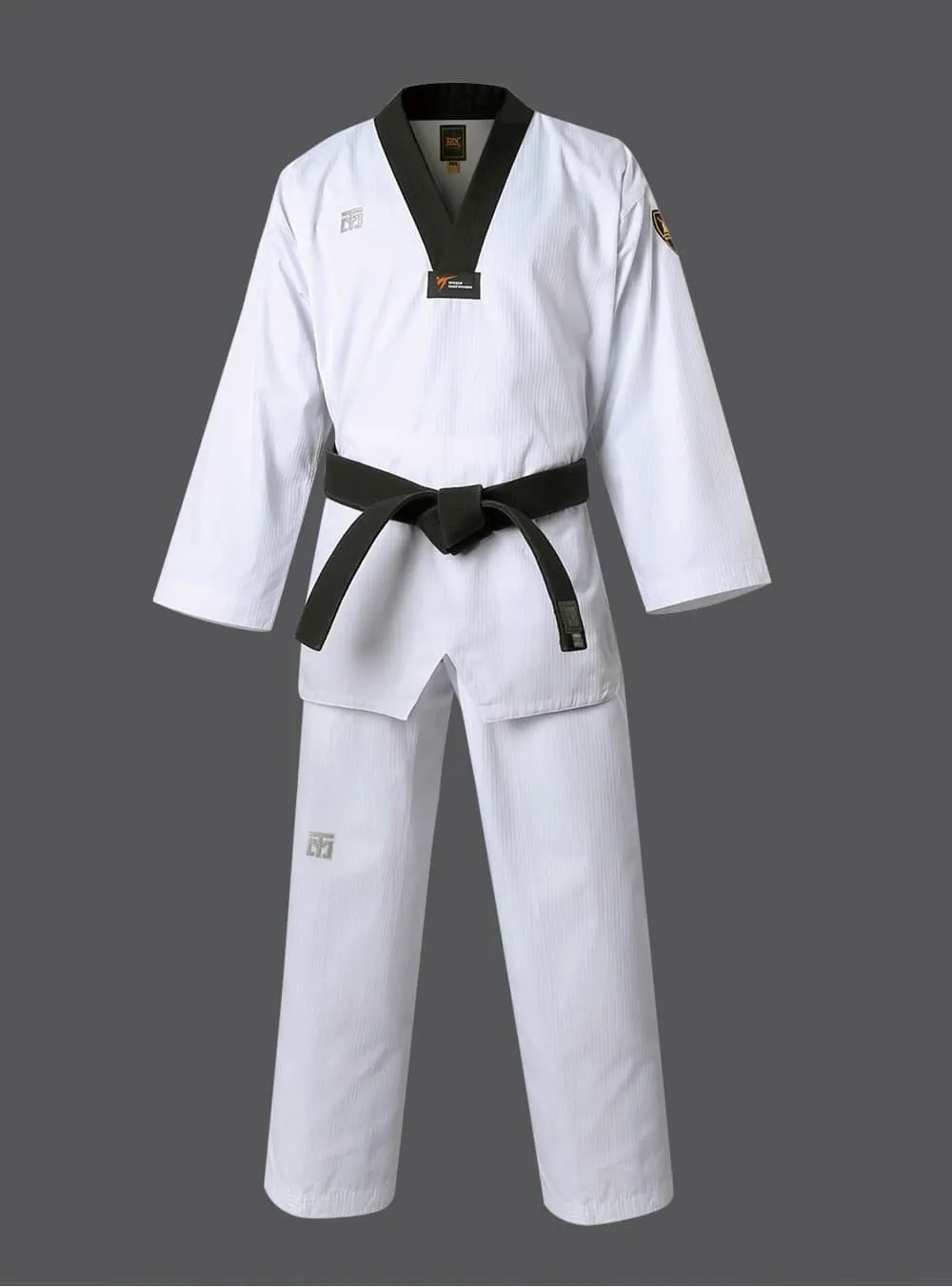
A well-fitted taekwondo dobok is fine for daily practice. For poomsae competitions, dedicated uniforms with the poomsae collar make the rank easier for judges to identify.
journal.takeaways
- →Taegeuk 1-8 = required curriculum from white belt to red-black belt, tested in every exam
- →Chapters 1-4 build the base: stable stances, complete pivots, power from the waist
- →Chapters 5-8 build rhythm: fast and slow clearly separated, moves with a start and end
- →Three-stage method: chapter breakdown, pair comparison, full-set run
- →Poomsae and sparring complement each other - solid poomsae means solid sparring fundamentals
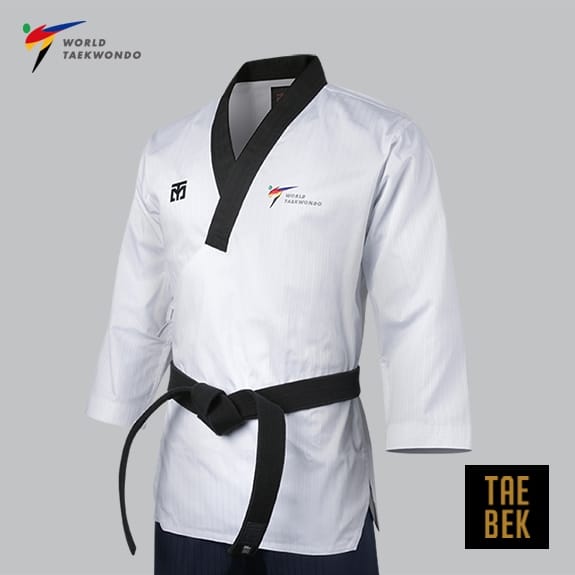
Taebek 2 Poomsae Uniform Dan Male
韩国原装太白品势服 WT认证款