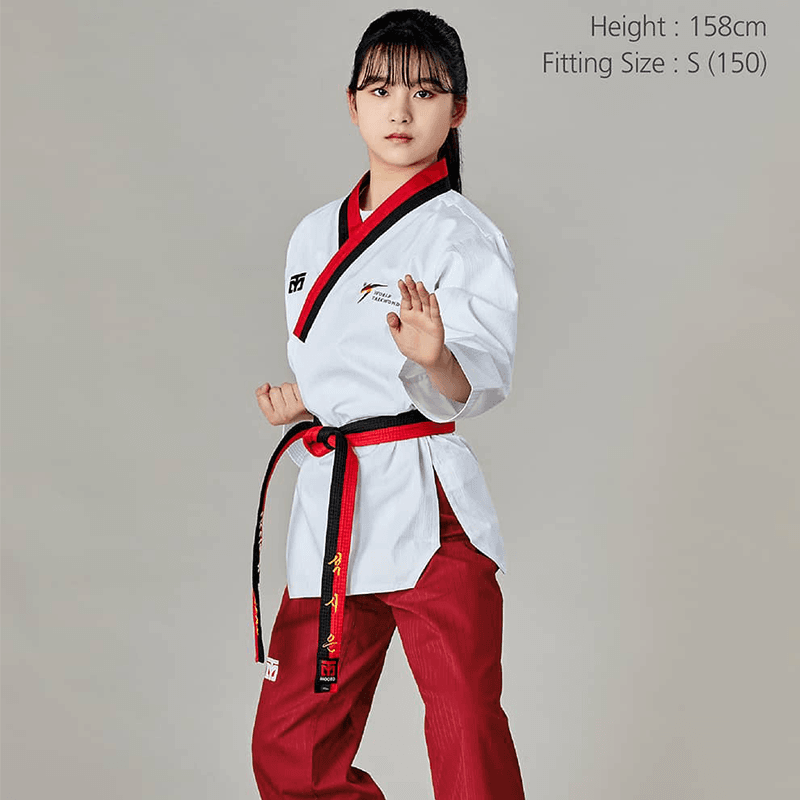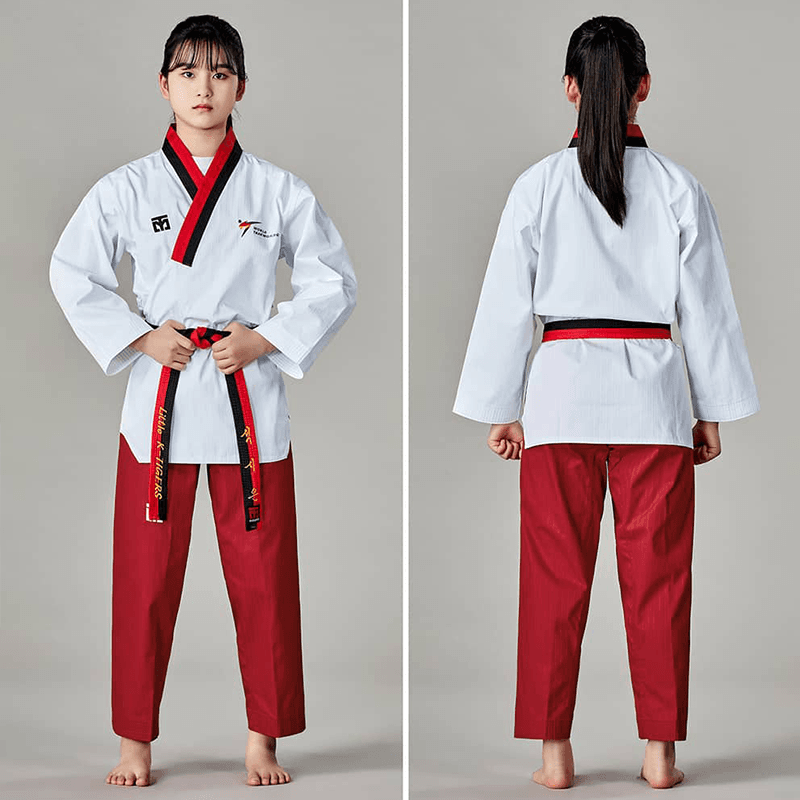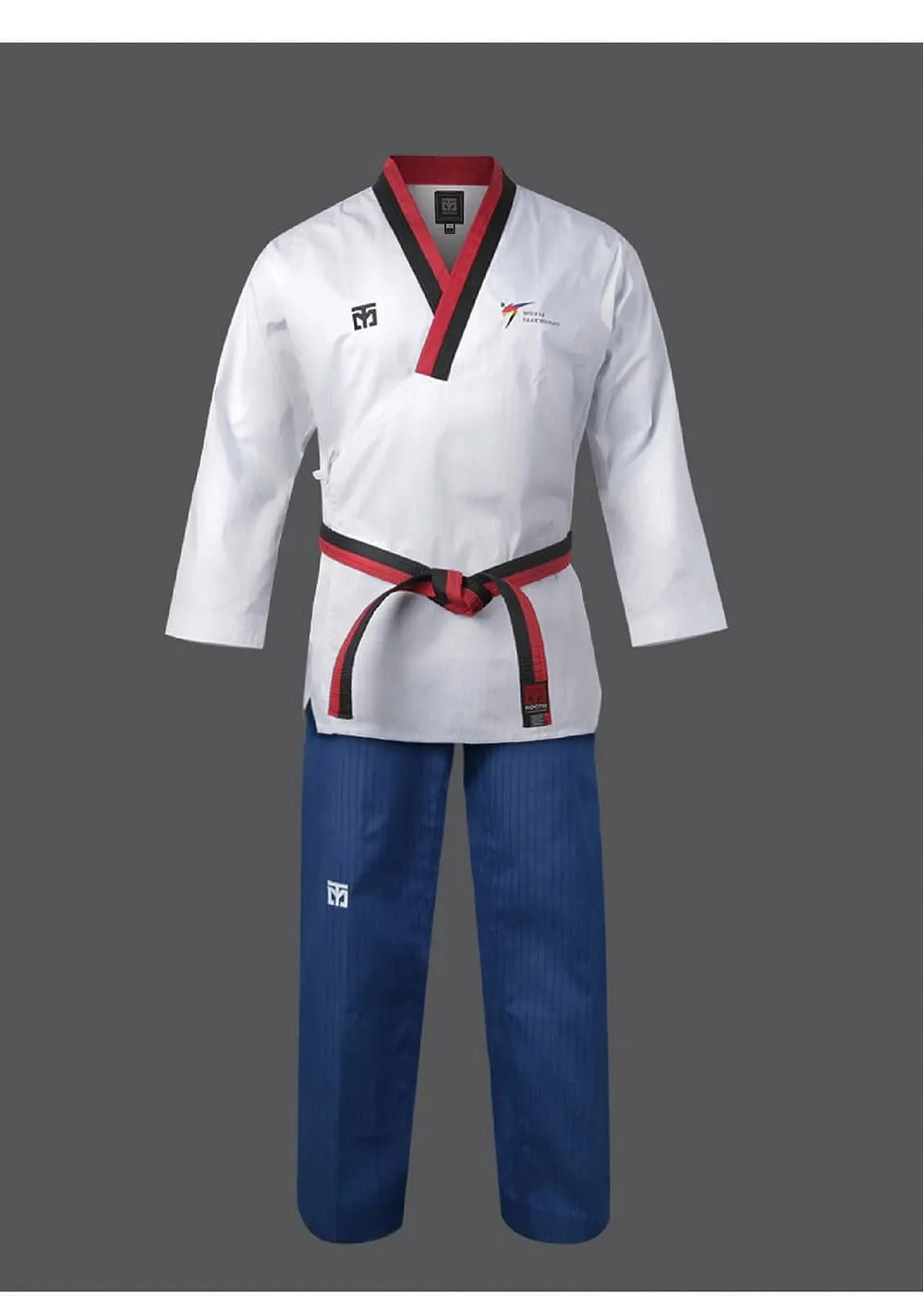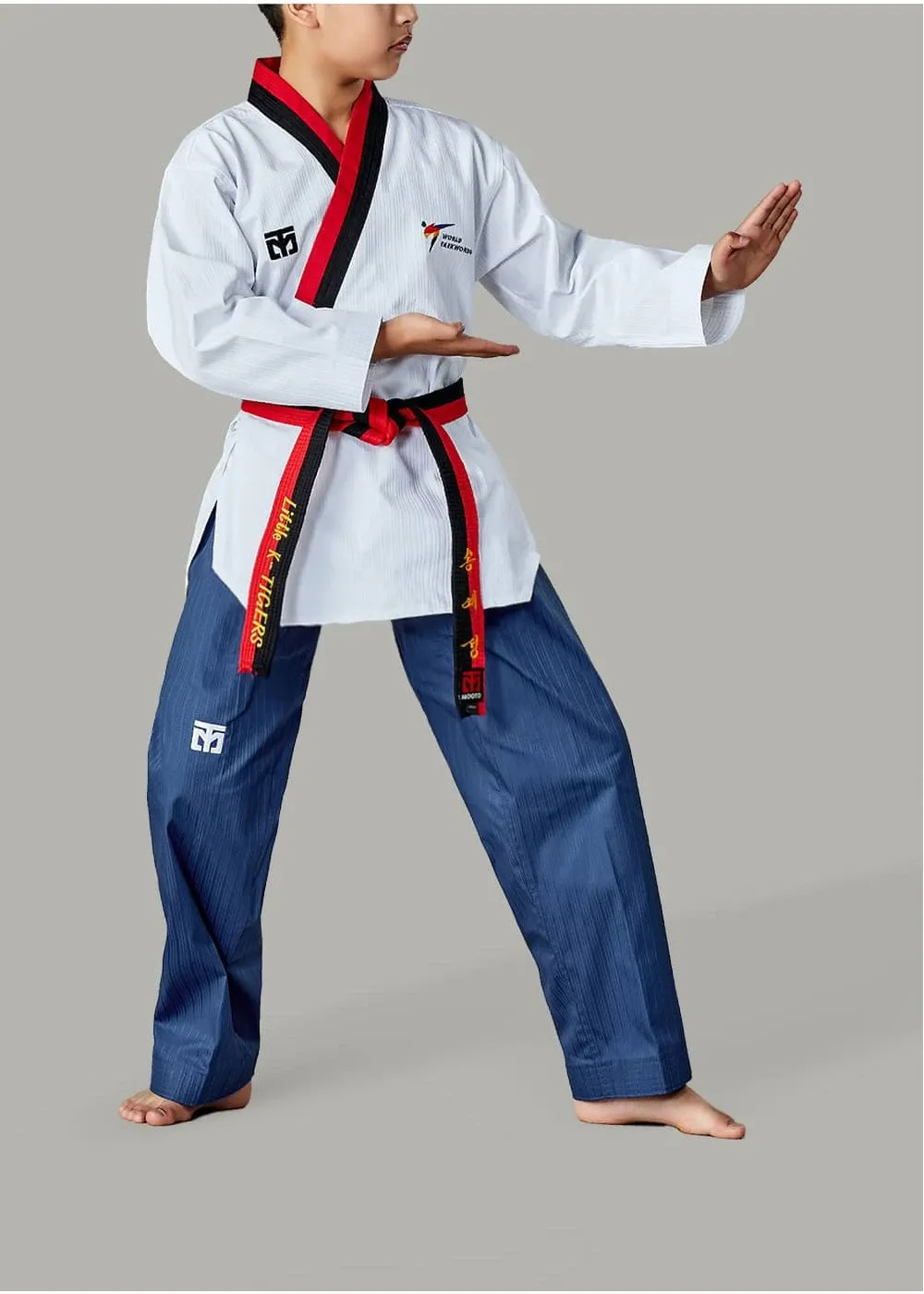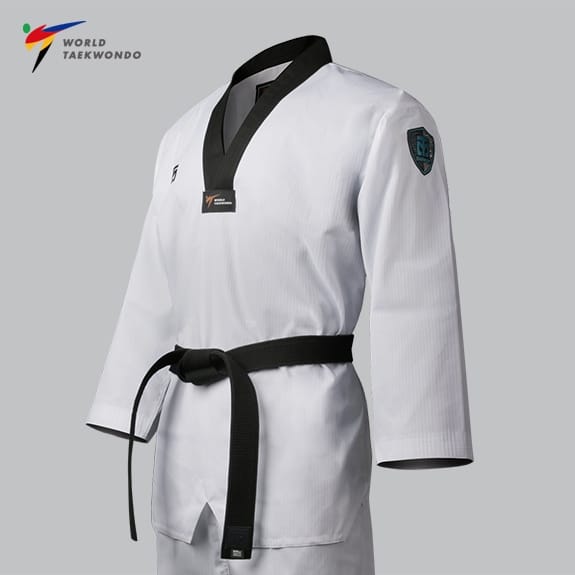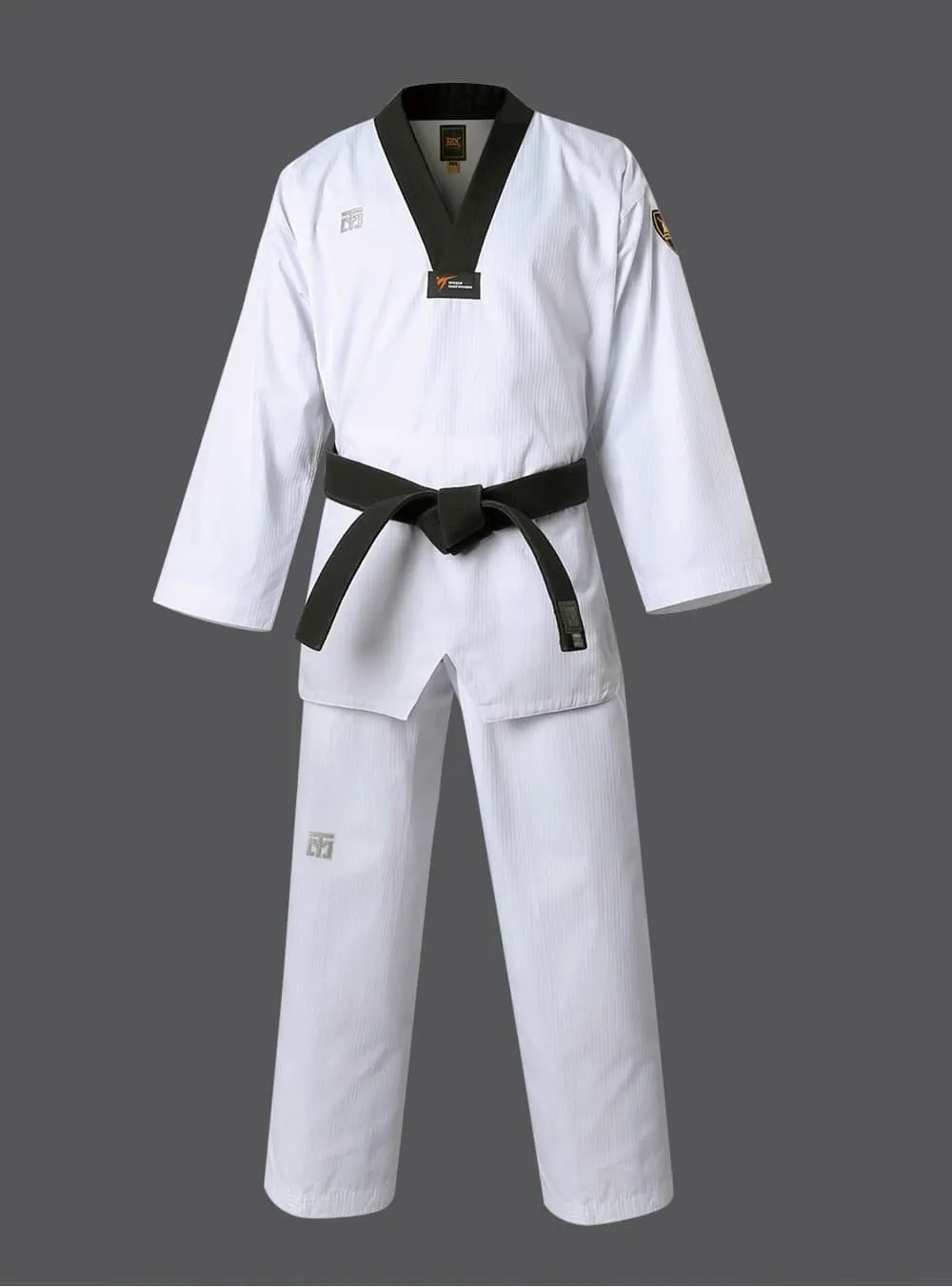
Poomsae and kyorugi run on two different equipment logics. A kyorugi dobok has to be light, close-fitting and able to keep up with continuous kicking. A poomsae dobok has to hold its shape, stand up on its own, and define clean lines while the athlete is momentarily still. Using MOOTO's Taebek poomsae dobok as the thread, this article explains how the two differ in collar, fabric and construction - and what buyers should actually verify when they ask for a quotation.
1. Poomsae and kyorugi dobok diverge at the pattern stage
First, clear up a common confusion: a taekwondo dobok is not one universal jacket. The kyorugi dobok is built for combat - light fabric, high elasticity, a closer cut - to cut drag and friction on every kick while still allowing the leg to rise freely. The poomsae dobok is built for demonstration - a firmer fabric and a more structured build, because in poomsae the judges read line, speed and power, and a crisp, well-defined silhouette is part of that impression.
That is why one factory runs two product lines in parallel. In MOOTO's catalogue, the kyorugi side is the EXTERA 6 and Extera Pro 2/3 competition dobok; the poomsae side is Taebek and Republic. They share the same brand and certification system, but the pattern, the materials and the target scenario are entirely different.

2. The collar: the detail most people misread
The collar of a poomsae dobok is not a design preference - it is a rank marker. Standard international practice: a white collar corresponds to geup grades (colour-belt level). Once an athlete reaches dan (black belt) or poom level, the uniform switches to a black collar or a poom neck - a black collar finished with a white trim. This is why the same Taebek model is split into a dan version and a poom version in the catalogue: different collar, different eligibility.
For a dojang this changes how an order is written. You cannot simply list "20 Taebek dobok". Adult dan classes take a black collar, junior poom classes take a poom collar, colour-belt classes take white. Get the collar wrong and the uniform will be sent back at equipment check.
The short version: a kyorugi dobok solves the problem of moving, a poomsae dobok solves the problem of looking composed - and its collar is a rank marker, not a colour option.
3. Structure and construction: where the crisp feel comes from
The first impression of a poomsae dobok is usually firm and crisp. That comes from three structural layers working together. First, the fabric weave leans towards body and drape, so the silhouette does not collapse while the athlete holds a static form. Second, the front-panel overlap is built more precisely, so the jacket does not gape during large overhead or turning movements. Third, the cuffs and hem are finished more stiffly, so the line of the arm can be read clearly from the judges' table. Together they produce the composed look that demonstration demands.
The kyorugi side works the opposite way. Competition dobok such as the EXTERA 6 concentrate on elasticity and low weight, using stretch fabric and a closer cut to reduce pull during kicks. Neither approach is better - only better matched to a scenario.

4. Certification and buying: four things to ask for
MOOTO is an official partner of World Taekwondo, a partnership that dates back to 1984, and the Taebek poomsae dobok on this site are listed as WT certified models. At international level, a WT certified dobok is itself the baseline for entry. For a dojang or distributor, though, certification should not stop at one line on a product page. At the enquiry stage, ask for four groups of information at once: the certificate and the models it covers, the fabric specification and weight range, the rank split with a size chart, and the bulk lead time and customisation options. Give it all in one go and the quotation and production slot can be set in one round.
FAQ
Q1.Can I use a poomsae dobok for kyorugi, or the other way round?+
In training, dojangs have their own habits. For official competition, mixing is not advisable: poomsae events specify collar and style requirements, while kyorugi events require a light, close-fitting competition uniform. A mismatch can be flagged at equipment check.
Q2.Why is one Taebek model split by rank?+
The difference is the collar and the eligibility marker it carries - white, black or poom. Ordering by class composition is far less trouble than re-collaring the jackets afterwards.
Q3.What should I send for a bulk poomsae dobok enquiry?+
Send it all at once: intended use (poomsae classes or a competition team), rank mix (how many colour-belt, poom and dan athletes), required size distribution across CN/EN sizing, quantity, whether you need custom dojang marking (embroidery or print), and your required lead time.
If you run a dojang or a distribution business and are planning to refresh a poomsae class, send us your class composition and quantities through the enquiry form and we will propose a rank-split configuration with pricing. For more equipment deep dives, browse the Product Stories category. If this is your first purchase and you need to understand how sizing maps to styles first, start with the buying articles in the Product Guides category.
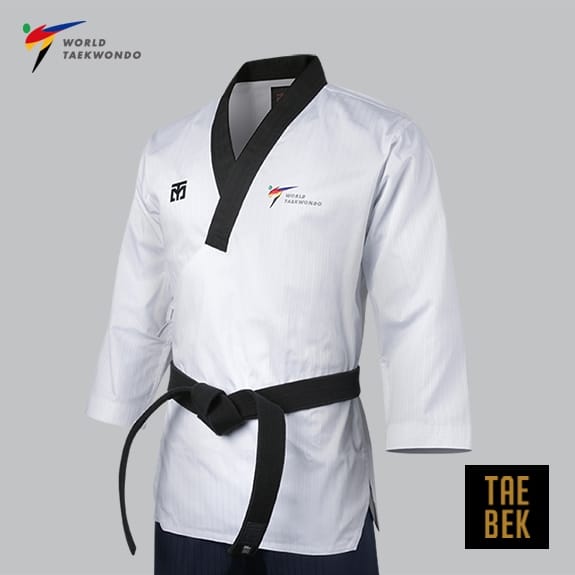
Taebek 2 Poomsae Uniform Dan Male
韩国原装太白品势服 WT认证款
KEY TAKEAWAYS
- →Poomsae and kyorugi dobok are two design logics: silhouette and structure versus light weight and elasticity
- →The poomsae collar is a rank marker - white for geup, black and poom for dan and poom holders, with models split accordingly
- →The crisp feel comes from fabric weave, front-panel construction and edge finishing, not simply thicker cloth
- →MOOTO has partnered with World Taekwondo since 1984, and Taebek poomsae dobok are listed as WT certified models
- →For bulk enquiries, send use case, rank mix, size distribution, quantity, customisation and lead time together