The chest guard is the odd one out in a taekwondo kit. Hand protectors look after you, headgear looks after your head, but the chest guard has to absorb trunk impacts and, in the electronic-protector era, feed the scoring system at the same time. That dual role is why the question "approved or training grade?" needs a clearer answer for the chest guard than for any other piece you buy.
Why the chest guard sits in a category of its own
Taekwondo protectors are configured piece by piece by body area: hands, feet, forearms, shins, trunk, head, mouth and groin all cover a different impact zone. The trunk is the highest-frequency scoring zone in competitive sparring, so the chest guard carries two jobs at once - protecting the ribs and abdomen, and sending a valid impact signal to the electronic scoring system.
That dual role has a consequence buyers often miss: a chest guard cannot be chosen on thickness alone. Thickness only affects how protection feels. What actually decides whether a guard gets you onto the mat is certification scope, sensor compatibility and fit.
WT-approved vs training grade: the difference is scope, not padding
What approval actually solves
The value of an approved model is not a performance ranking; it is specification consistency. Approval is fundamentally an admission standard: the model has met the consistency of spec, material and construction that equipment inspection at a competition requires, so the same model can move between events without being re-assessed.
For athletes competing in official events and the coaches travelling with them, the practical benefit is certainty - nobody has to worry at inspection about whether a piece of gear will pass. That is why, for competition use, we generally recommend buying the whole set to the approved standard in one go rather than trialling a training-grade piece first. For guidance on building the set position by position, see our earlier breakdown of electronic-protector gear setup.
Where a training-grade chest guard belongs
A training-grade chest guard is not a downgraded approved model; it serves a different requirement: daily sparring classes, youth programmes and beginners in larger weight classes. These settings share three traits - high turnover, a wide spread of sizes, and wear concentrated on a small number of frequent users - so budget and size coverage matter more than certification scope.
In one line: official competition, buy to the approved standard. Daily dojang sparring, buy for size coverage and budget. The two follow different logic, so do not force one standard onto both.
Four checks you can run on the spot
1. Structure and padding
Protection comes from a layered build: a wear-resistant outer skin over cushioning, with the two divided by stitching into relatively independent padded cells. Press the guard and feel whether the rebound is even across cells. Uneven rebound means the weakest cell will collapse first under repeated impacts - and the first place to go is usually the central front segment, which takes the most hits.
2. Sizing and fit
Chest guards are normally sized on height and chest circumference, with height as the primary basis. Leave one critical allowance: the lower edge should sit below the rib arch, and the top should not press on the collarbone. Too small a guard rides up when the arms lift and exposes the ribs; too large a guard shifts during turning techniques, which hurts both scoring and comfort. Both can be tested in the fitting room with a simple arm raise and body turn.
3. Two-sided or single-sided
Chest guards divide by how many faces they can be worn on. A two-sided guard is red on one face and blue on the other, so a single unit covers either competitor - useful for dojangs and for training where sides change often. A single-sided guard has a simpler structure and clearer segmentation, which suits daily training and spares where the wearer keeps one identity. The deciding factor is how often sides change in your training, not the price gap.

4. Electronic protector compatibility
Once electronic protectors bring trunk gear into the scoring chain, whether a chest guard has to match the event's system becomes a precondition that must be confirmed event by event. Competitions run different systems and versions, and whether the organiser supplies trunk electronics varies too. The reliable approach: read the competition outline first, confirm the system and the split between organiser-supplied and athlete-supplied items, and only then decide which guard travels with you.

We have already turned the pre-competition check of system and supply split into a usable checklist in our guide to electronic-protector gear setup. The chest guard is only one box on that list, but it is the one most likely to be packed and then never used.
Size ratios for dojangs and dealers
The two most common losses when a dojang buys chest guards are dead stock and sold-out sizes - and they usually happen together: the popular sizes clear out while the slow ones pile up. The fix is not complicated. Work out the ratio from your student mix before ordering, instead of dividing the total evenly across sizes.
The ratio starts from your students' height distribution. Classes dominated by children and teenagers need a visibly higher share of small and medium sizes; classes built around an adult competition squad concentrate demand in large and extra-large. Once the ratio is set, split the order into competition grade and training grade so approved stock is not consumed by daily wear. For the full piece-by-piece logic, work through our complete taekwondo protector buying guide; more buying guides sit in the product guides section. Dojangs and dealers planning a full protector set can send an inquiry through the website for ratio advice and bulk pricing.
"Waste in protector purchasing rarely comes from unit price. It comes from the ratio. Working out your height distribution in advance is worth more than two extra points of discount."
Frequently asked questions
FAQ
Q1.Do I have to buy an approved chest guard?+
It depends on whether you compete in official events. If competition is the goal, buying to the approved standard removes uncertainty before the event. If the guard never leaves your dojang, a training-grade piece sized to your students and budget is enough.
Q2.Two-sided or single-sided chest guard?+
Choose two-sided when sides change often or one unit needs to cover several students. Choose single-sided when the wearer keeps one identity and you want a lighter, simpler structure. Decide on how often sides change in training, not on the price difference.
Q3.Can I size a chest guard by body weight?+
We would not make weight the primary basis. Height first with chest circumference as a correction is more reliable, and the same nominal size varies between cuts - try the guard on before committing.
Key takeaways
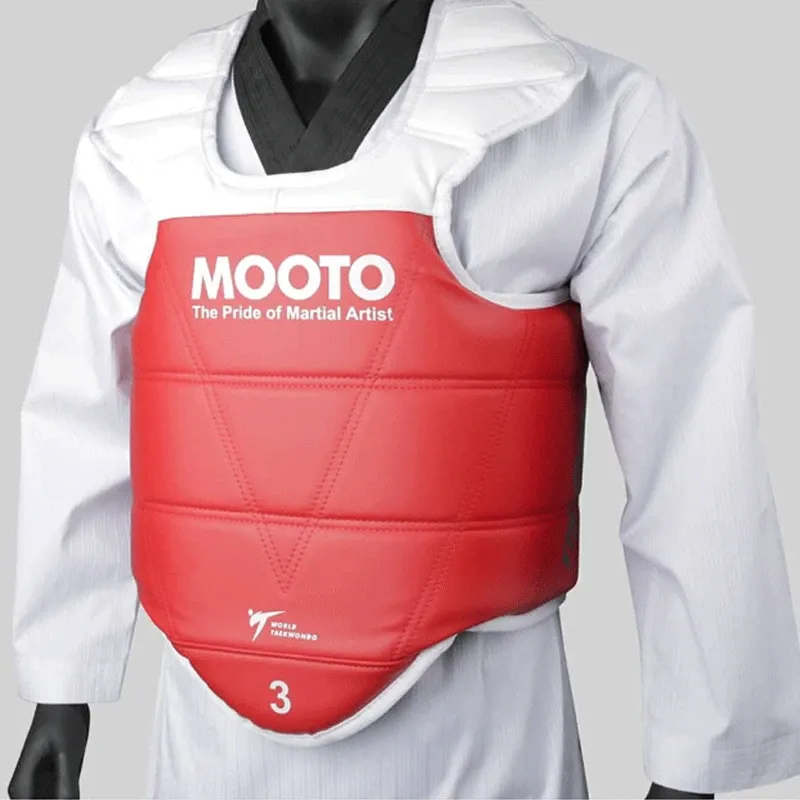
MOOTO 2 Reversible Chest Guard
请输入产品描述...
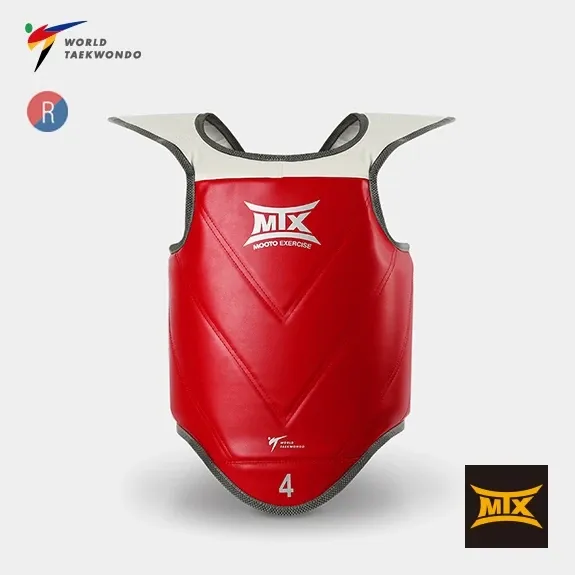
MTX 2 Reversible Chest Guard
'MTX’是为全球所有跆拳道运动员的初级训练及比赛提升而设计的产品线。不仅品质优良,价格合理,任何跆拳道选手均可无负担地佩戴使用。
KEY TAKEAWAYS
- →The chest guard is the only protector that carries both protection and scoring, so it is bought differently from hand or head guards.
- →Approval answers competition-admission certainty, not a performance ranking; buying the full set to the approved standard beats trialling a training-grade piece first.
- →Training-grade chest guards serve daily dojang sparring and youth programmes, where budget and size coverage outrank certification.
- →Size by height first and chest circumference second, then test in person that the lower edge covers the rib arch and the top clears the collarbone.
- →Dojangs should set size ratios from their student height distribution, then split competition-grade from training-grade stock to ease both dead stock and sold-out sizes.