When a dojang decides to host an official competition, the first question is rarely about referees or the schedule. It is about the floor: is the contest area a full 8 metres, how much safety margin is left around it, and are the mats the approved type? Those three answers decide whether the event can be sanctioned at all - and they set the budget and timeline that follow.
The MOOTO Facility team builds competition flooring plans for dojangs and sports venues worldwide, delivering measurement, layout design and installation guidance as one package. This article translates the court parameters in the World Taekwondo (WT) competition rules into a matting checklist you can take straight to a quote - understand the standard first, then talk budget.
The core numbers: an 8m x 8m contest area that already includes a 60cm boundary line, a safety area 2-4m wide, and a total court of 10m x 10m to 12m x 12m. If the numbers do not line up, the venue inspection will not pass.
1. Contest Area and Safety Area: Three Numbers Define the Court
WT competition rules describe the floor in two layers. The inner layer is the contest area where athletes actually engage: a square 8m on each side. Note that this 8m already includes the surrounding 60cm boundary line - the coloured band used for out-of-bounds calls - so it cannot be extended outward. The outer layer is the safety area, at least 2m wide on all sides; in practice events use 2-4m, and larger surfaces give athletes more room to decelerate from high-speed movement.
Add the two layers and the total court side length lands between 10m x 10m and 12m x 12m. The most common mistake organisers make is renting a hall for 8m x 8m. Only when they try to place the recorder's desk, coach seats and the inspection table do they find that ten metres square is simply not enough. What you actually need to reserve is 12m x 12m of clear floor plus standing room on all four sides.

2. Square or Octagonal: How to Specify the Mats
For a square court, 1m x 1m puzzle tiles are the most direct answer. A full 12m x 12m coverage takes 144 pieces - which is exactly the official configuration MOOTO Korea specifies for its WT-approved puzzle mat: 144 tiles make one complete standard court. The tiles interlock along their toothed edges and share one surface texture, so the floor has no directional bias; boundary lines can be laid in a contrasting colour from the same family instead of taped on.
An octagonal court uses a contest area that is an octagon 8m in diameter with each side 3.3m long. Forcing square tiles into that shape leaves a lot of jagged waste, so a dedicated octagon tile is required: MOOTO's WT-approved octagonal puzzle mat is 80cm x 80cm, and the official configuration is 196 pieces for one complete court. The octagonal layout reads closer to international championships and broadcast framing, but it demands tighter layout accuracy and a matching allowance for edge trimming.
"The court shape determines the mat format; the mat format determines quantity and budget. The order never reverses."
3. Surface and Colour: The Requirements Everyone Skips
The rules set three baselines for the mat surface: it must be non-slip, it must not produce harsh glare, and the contest area and safety area must use two clearly distinguishable colours. A glossy surface under venue lighting makes athletes misjudge distance and ruins broadcast quality; insufficient grip is the most concrete fall risk, especially during hard stops and pivots in high-intensity sparring.
The other item frequently skipped is the platform. The contest area can sit on the floor, or on a platform 0.6-1m high, which reads closer to the televised spectator angle. But platform edges must be protected, and the platform's own flatness has to hold within a very small tolerance - otherwise interlocking seams work themselves open under repeated impact and become a hazard.
4. Where People and Desks Go: A Positioning Checklist
Laying the mats is only step one; the reserved positions around them are also part of venue inspection. In the standard arrangement: the two athletes start 1m from the centre point, facing each other; the referee stands 1.5m from the centre toward outer line 3; the recorder's desk and the instant video replay (IVR) station sit 2m outside outer line 1; coaches stand at least 1m out from the centre of their own outer line; and the inspection desk sits near the venue entrance for gear checks.
These distances look like trivia, but they decide whether you need an extra circulation aisle around the court. Working from a 12m x 12m court with 2m of functional zone on each side, a competition floor that actually runs needs roughly 250 sqm of usable area - the item most often underestimated by a dojang hosting its first sanctioned event.
5. Five-Step Acceptance Before You Host
First, measure clear floor area and ceiling height, and confirm the door and freight lift can take full rolls or pallets of tiles. Second, fix the court shape and total dimensions and produce a layout drawing marking columns, corners and skirting. Third, specify mats by shape - 1m x 1m for square courts, 80cm x 80cm for octagonal ones, or full-sheet roll matting if you want fewer seams. Fourth, calculate quantity with a 5-8% allowance for irregular and edge areas. Fifth, inspect on site: seams interlocked and offset, boundary lines straight, platform edges protected, and contest versus safety colours clearly separated.
If you are converting an existing dojang, start with our guide to buying and installing dojo mats to lock in density and thickness first. Once the event is over and the floor returns to daily training, set up a cycle based on our mat maintenance and inspection guide so a single investment lasts longer.
KEY TAKEAWAYS
- →Contest area 8m x 8m including the 60cm boundary line; safety area 2-4m; total court 10m x 10m to 12m x 12m
- →Square courts use 1m x 1m tiles - the official configuration is 144 pieces per court
- →Octagonal courts use 80cm x 80cm octagon tiles - 196 pieces per court
- →Surfaces must be non-slip and non-reflective with contrasting area colours; platforms 0.6-1m high with protected edges
- →Athletes 1m from centre, referee 1.5m, recorder and IVR 2m outside outer line 1, coaches at least 1m out
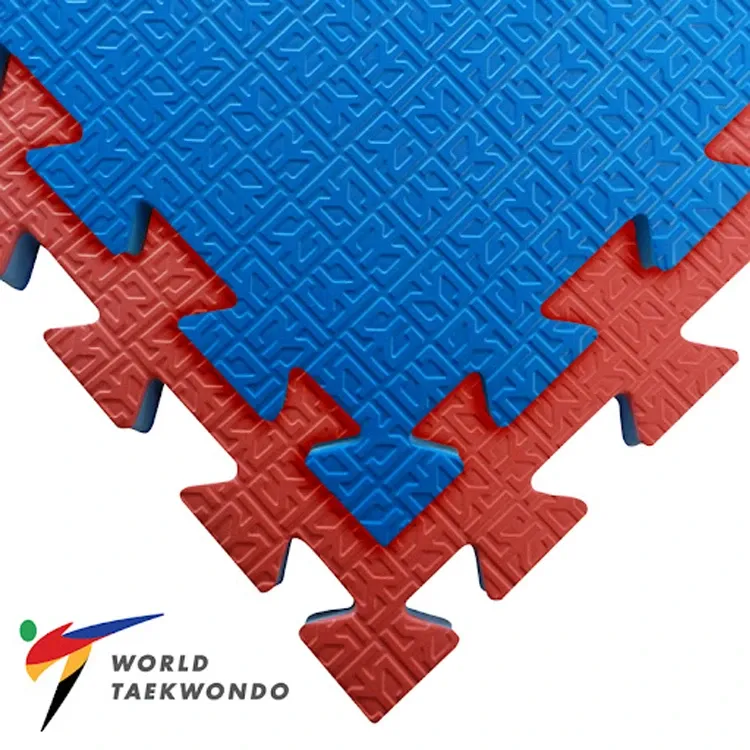
MOOTO PUZZLE MATS
MOOTO splicing mat (excluding tax and logistics transportation costs)
Hosting an event puts the floor first in line for inspection and last in line for quick fixes. Send us your floor dimensions, available ceiling height and competition discipline, and the MOOTO Facility team will return a layout drawing, matting schedule and itemised quote within one business day. More venue and operations guidance lives in our Dojo Business section.