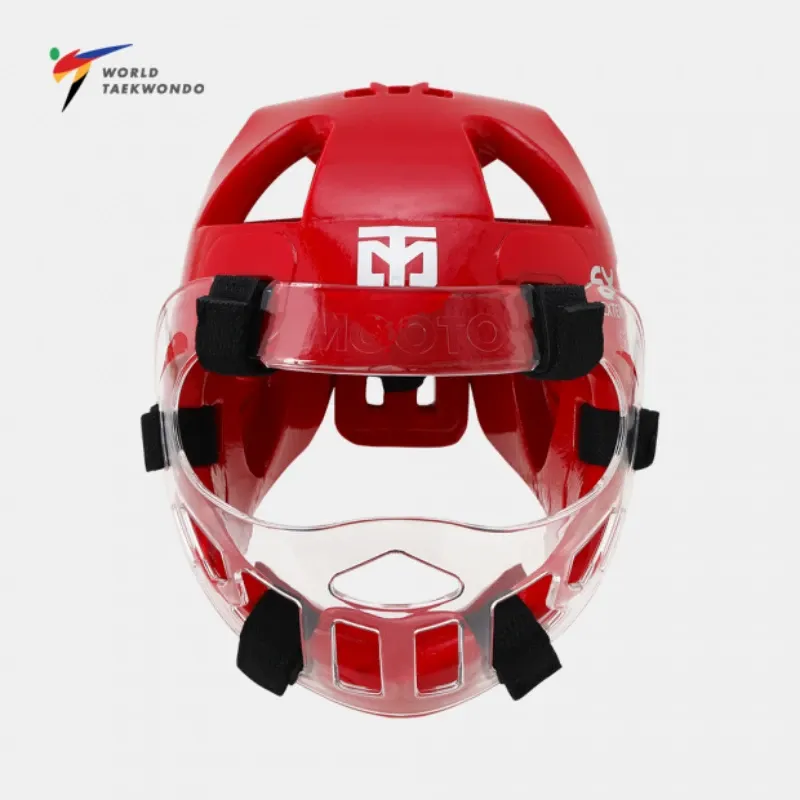
Headgear usually sits behind the chest guard on a dojo shopping list, on the reasoning that it only matters for sparring. The real problem is not priority but method: it gets bought in one run of "universal" sizes, then handed out by age or belt grade, until someone complains the field of view is squeezed or an equipment check reveals the face cover sits in the wrong place. This guide splits the choice into four parts: the two forms, what a face cover actually trades, the three measurements that set the size, and how shared headgear should be cleaned, rotated and retired.
Two forms, not two grades
Structurally, headgear does one job: it wraps the most vulnerable parts of the skull with continuous coverage across the forehead, temples, the area around the ears and the occiput. The difference between a face-covered model and an open-face model is whether an extra rigid shell covers the front of the face. It is not a difference in protection grade.
An open-face model keeps protection at the forehead, temples and around the ears, leaving the front of the face clear. The benefit is an uncut field of view and almost no breathing resistance; you can hear your own breathing rhythm and the coach calls. For training built on footwork, distance control and timing, that directly affects movement quality.
A face-covered model extends a shell below the forehead across the bridge of the nose, the cheekbones and the front edge of the jaw. It blocks the two most common contacts in sparring: grazing contact as an opponent raises a leg, and misdirected strikes when distance breaks down. The cost is equally clear - the edge of the view gets framed, facial space narrows, and breathing and heat dissipation become harder over long sessions.

Three gains and three costs of a face cover
The first gain is coverage. Taekwondo sparring is dominated by kicks entering from above and from the side, and the face shell sits exactly where those lines land on the nose and cheekbones. The second is tolerance for error: distance control in cadet and amateur divisions is less consistent, so misdirected strikes are more frequent and the shell earns more on the same mat.
The third gain is psychological. Athletes competing for the first time are generally more willing to step into mid-range when wearing a face cover. That difference is real in a dojo teaching context and belongs in the stocking plan, rather than being rationed by a "senior grades only" rule.
The first cost is vision. The frame of the shell compresses effective vision below and diagonally below, which matters most for athletes who counter low and read low-line attacks. The second is breathing and heat: a face cover creates a semi-enclosed space over the face, and stuffiness accumulates across repeated high-intensity rounds. The third is equipment-check fit - competitions set their own requirements on gear configuration, so it has to be checked event by event rather than assumed.

Sizing: three measurements, not age or belt
Headgear sizing is the most quietly mismanaged item in gear procurement. Sizing by age runs small, while sizing by belt grade puts adult sizes on middle-school students. The workable method uses three measurements. First, head circumference, taken around the forehead above the brow and the most prominent point of the occiput. Second, ear height - the ear openings must align with the centre of the ear; too high presses the base of the ear, too low exposes the occiput.
Third, occipital coverage. With the headgear on, tipping the head down should not let the rear edge ride up and expose the lower occiput; tipping it back should not bring the front edge down onto the eyebrows. If two of the three checks fail, that size is wrong for that person even when the circumference number falls inside the range.
Size headgear by three measurements - circumference, ear height and occipital coverage. Two failures mean change the size.
One more check for face covers: clearance at the nose
A face-covered model needs one extra step after sizing: there must be clearance between the tip of the nose and the shell. When the shell rests on the bridge of the nose, impact travels straight through it into the nasal bone and protection becomes a risk source. It is easy to test during a fitting - press the shell lightly with the palm; if it gives slightly and springs back, there is cushioning.
Sizes for a face-covered and an open-face version of the same model often do not interchange. The shell shifts the centre of mass and the load path at the front, so contact points move up; always fit the version that will actually be worn.
Model and colour choices are more straightforward. The MOOTO official site lists five headgear models: the open-face options are EXTERA 2 Headgear and MTX 2 Headgear; the face-covered options are EXTERA 2 Pro Face Covered Headgear and EXTERA 3 Pro Face Covered Headgear, the latter in red and blue, matched to team colours where kit is unified.

Dojo procurement: cleaning, rotation and retirement of shared headgear
Headgear in a dojo falls into three uses: personal issue for competition-team athletes, class-shared sets for trial classes and large groups, and spares for equipment check and lending. Each places different demands on the same item, and buying them as one block is the most common waste in dojo gear sourcing - shared sets wear fastest yet often draw the same specification and the same budget as personal issue.
The first filter for shared headgear is not price but whether the liner is removable. Headgear is worn against the skin and absorbs sweat directly; a fixed liner can only be wiped as a whole, which limits how deeply it can be cleaned. A removable liner can be washed and dried separately and rotated, which changes both hygiene and service life noticeably.
our lower-body protector guide. Spares at 10-15% of the number in use cover a semester of natural attrition without creating long-term stock.
A stocking ratio built on class structure
One workable ratio: the competition team gets personal issue in full, with the share of face-covered models set by competition division and the athletes distance control; large classes run mainly open-face because vision and breathing bear directly on teaching efficiency; trial classes and open sessions get a separate batch of washable shared sets, not mixed with regular classes.
Product Guides and send athlete numbers, age range and competition divisions through the website inquiry - we will return a size band based on head circumference distribution together with a bulk configuration proposal.
"Headgear proves itself not on a spec sheet but in whether an athlete is willing to wear it into mid-range."
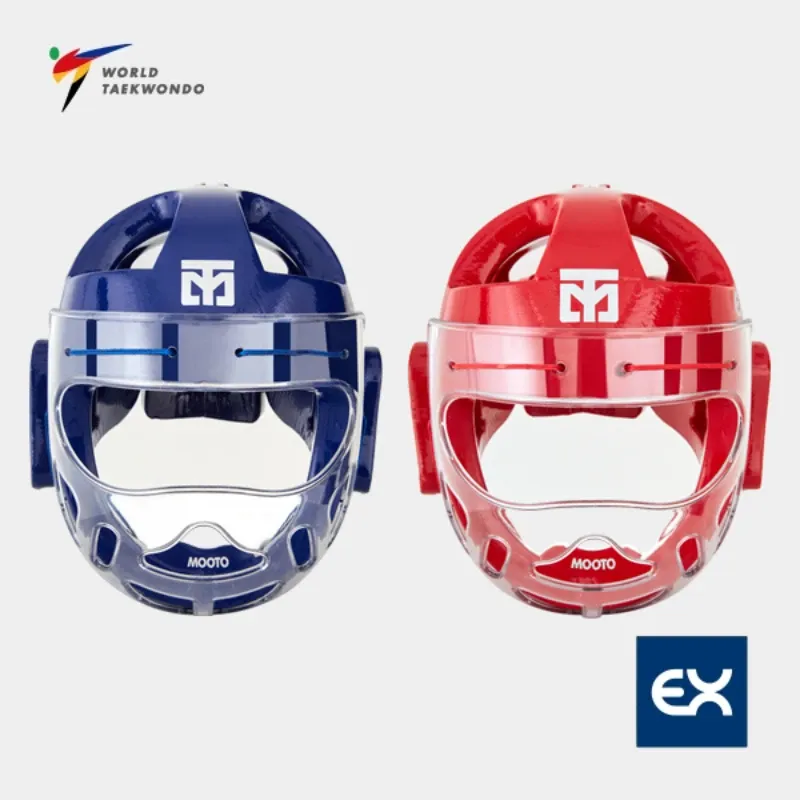
EXTERA 2 Pro Face Covered Headgear
为毫秒而生。世界跆拳道联盟官方认证。
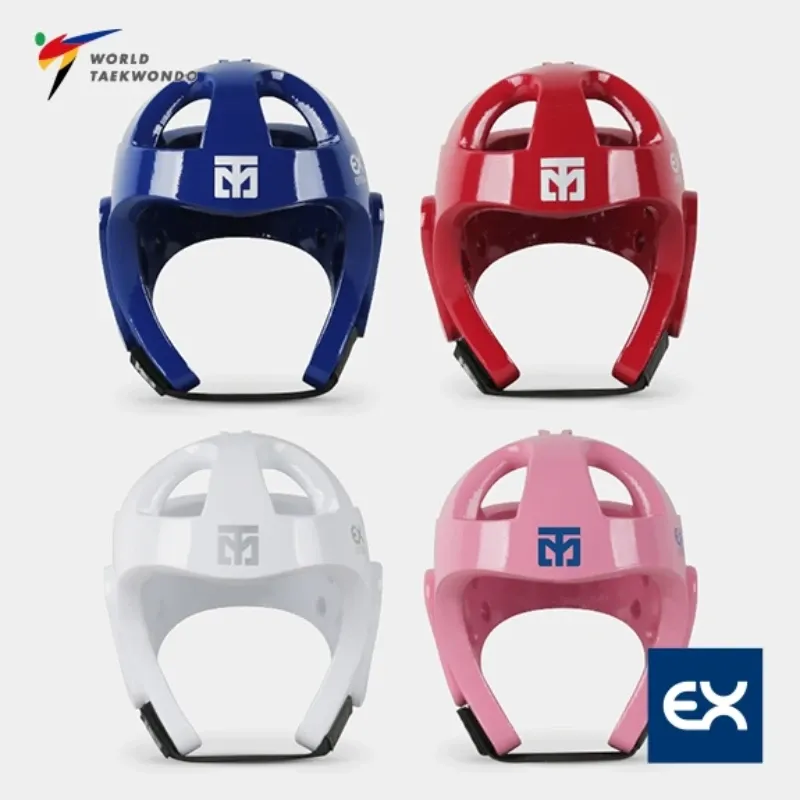
EXTERA 2 Headgear
为毫秒而生。世界跆拳道联盟官方认证。
KEY TAKEAWAYS
- →Face-covered and open-face are two forms, not two grades: one buys coverage, the other buys vision and breathing room.
- →Size headgear by circumference, ear height and occipital coverage; two failed checks mean change the size.
- →Face covers need clearance at the nose tip - a shell on the bridge transfers impact into the nasal bone.
- →For shared sets, prioritise a removable liner and retire on condition, not on age.
- →Stock in three layers - personal issue for the competition team, shared sets for large classes, a separate washable batch for trials - with spares at 10-15% of the number in use.