Many trainees know the feeling: a kick looks correct in practice, then falls apart on the target or in sparring - weak power, poor accuracy, or a spin that leaves you off balance. The problem is rarely talent; it is usually small faults that quietly settle into the movement. The back kick, axe kick and side kick are the three most frequently used kicks in taekwondo training and competition - and the most error-prone. This article breaks down their most common deformations from the perspective of the power chain and provides correction methods you can put into your training plan today, helping athletes and coaches turn looking right into doing right.
1. Back Kick: Three Most Common Deformations
The back kick is a key weapon for counter-attacks and closing score gaps, but because it fires toward a target you cannot see, its deformation rate is far higher than front-facing techniques. Three faults appear most often.
Fault one: turning the head too early. Many athletes look at the opponent before kicking; the head turn drags the shoulders open and the back kick becomes a blind turn-and-thrash - it telegraphs intent and wastes hip power. The correct order is: pivot on the support foot, turn the hip first, and only when the kicking phase begins should your eyes move to the target, with the head staying in sync with the body.
Fault two: incomplete extension. Kicking halfway and rushing to reach the target wastes the full rearward distance of the foot. Back kick power comes from full extension driven by the hip, not from snapping the knee. When practicing, focus on letting the heel travel far and feel how your body is pushed back by the drive of the sole.
Fault three: a high center of gravity and a stiff support leg. Locking the support knee turns the body into a rigid pole - unstable, unable to transfer weight into the kicking direction, and often requiring an extra step to regain balance after the kick.
Correction Drill: Wall-Assisted Decomposition and Hip Awareness
Place both hands on a wall or a target stand and practice only the support-foot pivot and hip rotation, without the full kick, until the body remembers that the hip moves first. Once stable, add the extension, and finally leave the support and perform the complete back kick. Film a side view on your phone each session and check three things: whether the head turns only after the kicking phase, whether the extension is complete, and whether your balance is stable on landing.
2. Axe Kick: Power Is Not Whipped Out
The axe kick has strong visual impact, which is why many practitioners turn it into a shin whip: the knee relaxes before the thigh reaches height and the shin lashes out like a whip. The motion looks large, but the heel lacks an effective downward acceleration path - the strike is weak and landing often ends off balance.
The second common problem is on the support side: leaning the upper body back too far and turning the support foot outward destabilize the pelvis and support leg, so after the kick you cannot stand firm and hand the opponent a counter window. Athletes who feel powerless should check this first instead of simply training harder and faster.
Correction Drill: Press with the Hip Flexion, Do Not Whip the Shin
Split the motion into two steps: first flex the hip and raise the knee to chest height, letting the knee relax and hang naturally; then press the thigh down actively to straighten the shin, dropping the heel onto the target like a hammer. Throughout, keep the pelvis facing the opponent and the upper body slightly forward rather than leaning back. In slow practice, feel that this pressing moment starts at the hip, not at the knee.
The simplest test of a correct axe kick is the landing: if you can stand firm without leaning back, the power came from the hip; if you stumble every time, you are almost certainly whipping the shin.
3. Side Kick: Linear Power and the Body Line
The side kick is the most typical linear technique, yet many athletes perform a fake side kick. The problem usually lies in two points: the hip does not rotate enough and the support foot still points forward, so the trajectory resembles a front kick with the force direction completely wrong; or the support foot fails to pivot about 90 degrees, so the hip, knee and foot cannot form one force line and the power is dissipated by the body itself mid-way.
Retracting the leg after the kick is also frequently neglected - leaving the foot hanging in the air hands the rhythm advantage away. In a truly high-quality side kick, retraction is as fast as the extension, and by the time the foot lands the body is already ready for the next move.
Correction Drill: Wall-Aligned Fixation and Penetration Practice
Stand side-on to a wall with the toes of the support foot against the wall line, and repeatedly practice the one-line sequence of knee-up, hip-turn, drive-out; the wall limits hip under-rotation. On a target, shift attention from hitting the target to passing through it, feeling the sole pushing continuously forward. Practice retraction as much as extension: after the kick, draw the knee back actively and go directly into the next technique or footwork without setting the foot down.
4. Building Corrections into Muscle Memory: Three Training Designs
Faults are stubborn because the nervous system has already memorized them. Correction is essentially overwriting an old program with a new one. Three training designs work well in stages.
First, slow decomposition. Split each action into three or four nodes (back kick: pivot-rotate-extend-land; axe kick: knee up-press down-strike-steady), practice node by node at slow speed, pausing one second after each node, and review on video. Slowness gives the nervous system time to encode the correct sequence.
Second, wrong-versus-right comparison. Deliberately perform the wrong version (early head turn, shin whip, closed hip), then immediately the correct version, alternating three times per set. Comparison sharply improves movement recognition, teaching the body exactly what the wrong feeling is like.
Third, fixed-to-random transfer. Practice on a target first; once stable, add footwork; finally apply randomly in conditional sparring. Muscle memory only truly exists when it can be called up under randomness - a textbook kick that cannot be produced in action is worth zero.
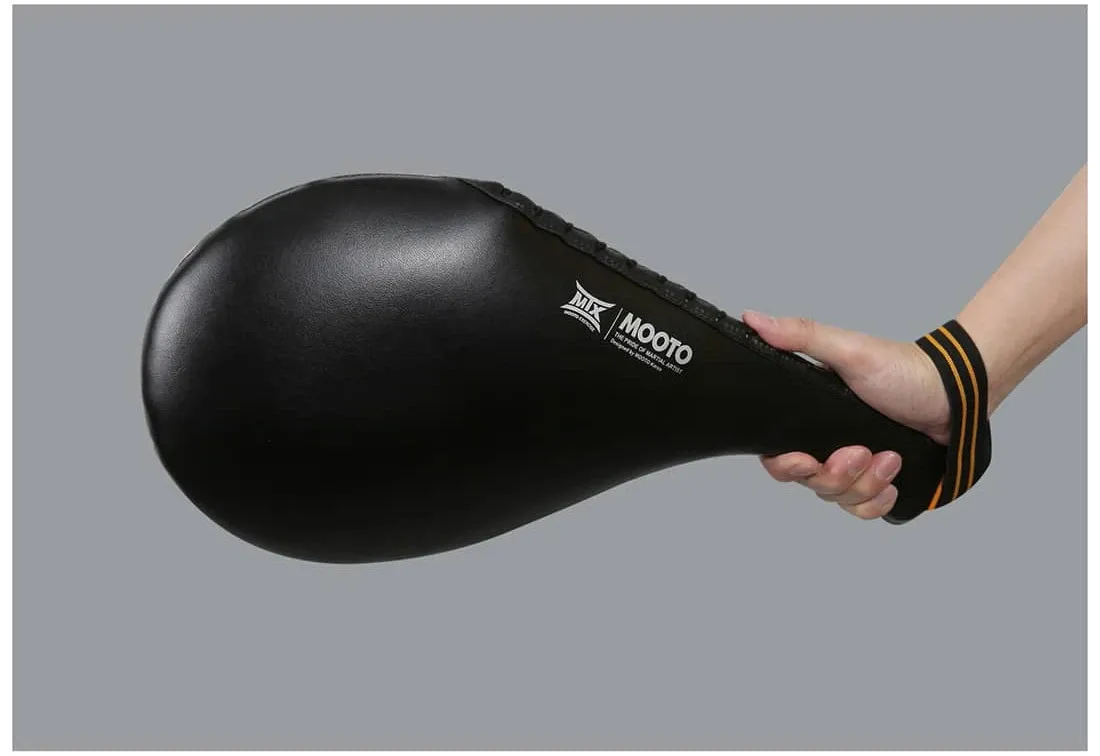
MOOTO MTX Target Mitt540 Tornado Kick ExplainedElectronic Protector Scoring Guide
5. Closing Thoughts
From a coach's perspective, correction is not fault-finding; it is rebuilding a movement once. There is no shortcut to fixing technique details, but there is a correct methodology: find the broken link in the power chain, then reconnect it with decomposition drills. If you run a dojo or coach a team and want a systematic technical assessment for your athletes, or need advice on training equipment from targets and protectors to competition dobok, please contact us through the inquiry on our website - MOOTO supports dealers and dojangs with bulk configurations and facility solutions.
FAQ
journal.faq
Q1.My back kick is always inaccurate and weak - where is the problem?+
Usually early head turns and incomplete extension: the head turn lets the shoulder bleed off hip power, and incomplete extension wastes effective range. Start with wall-assisted decomposition to fix the pivot-rotate-extend order, then leave the support for the full movement.
Q2.How can I add real power to my axe kick?+
Power comes from hip-flexion pressing of the thigh, not from whipping the shin. Slow-practice the three steps - knee to chest, thigh pressing down, heel dropping - keep the pelvis facing the opponent and avoid leaning back. If you land steady, the power path is right.
Q3.My side kick feels like a front kick - how do I change it?+
Check two points: whether the support foot pivots about 90 degrees and whether the hip opens fully to the side. Wall-aligned fixation limits under-rotation; imagine power passing through the target, not stopping on its surface, and build the habit of retracting after the kick.
Q4.Are these correction drills suitable for children?+
Yes, with attention to intensity and safety: at children's level, prioritize knee height, balance and movement order, reduce high-difficulty sparring and excessive load, always wear protection such as a mouthguard, and correct in shorter, more frequent sessions than with adults.
journal.takeaways
- →The back kick sequence is pivot on the support foot, turn the hip first, and turn the head only during the kicking phase - an early head turn is the number-one fault
- →Axe kick power comes from hip-flexion pressing of the thigh; shin whipping is both weak and unstable
- →The side kick needs hip, knee and foot on one line - a support-foot pivot of about 90 degrees is the prerequisite for linear power
- →Correction training should follow three stages - slow decomposition, wrong-versus-right comparison and fixed-to-random transfer - to overwrite old patterns
- →Use a quality target for fixed practice and always wear protection in sparring; safety comes before technique