Anyone who has trained taekwondo in a dojang for a few years usually discovers the same thing the first time a real conflict happens: the technique you are most fluent in during competition is not necessarily the technique you should use right then. Competition is scored inside a rule set; self-defense happens with no rule set at all, and the goal is to disengage. The targets are different, so the technique list has to be different too. This guide separates technique selection, distance control, close-range guarding and class programming so coaches and dojang operators can build a practical self-defense block.
Where competition technique and self-defense actually diverge
Competition comes with protectors, a referee and rounds. Both athletes work from the same rule set and the question is who scores more. A self-defense situation has no protectors, no referee and no whistle to end the round. Very often it begins at the moment someone has already closed into a distance you did not want them to reach. Carry competition habits straight into that situation and two failures show up repeatedly: waiting at range for the other person to move first, and trying to throw a large kick while already in contact.
From a programming standpoint, self-defense does not have to replace competition training. What it needs is a tiering exercise: which techniques can be carried over as they are, which need adaptation, and which simply do not belong in a self-defense core. That tiering is also the homework a dojang should finish before advertising a self-defense course.
Step one: tier the technique list
Keep first: linear kicks and front kicks
Front kicks and push kicks travel a short path, start quickly and need no large rotation, so they still work at closer ranges. Their value is not in knocking anyone down; it is in interrupting the other person's forward pressure and creating room to step back or sideways. Train the speed of the retraction and the stance you land in, not the height of the kick.
Basic blocks and stance transitions deserve to stay as well. In a self-defense context a basic taekwondo block provides a temporary protective plane; what really decides the outcome is the stance you take after the block. A block is not the end of the sequence, it is the start of your next movement. This is the part most dojangs skip when teaching self-defense: students remember the blocking motion but not where to move afterwards.
Adapt: spinning and high kicks
A 540 tornado kick or a spinning back kick is a high-value scoring action in competition, but it carries three costly traits in self-defense: a wind-up that is easy to read, a long period of single-leg support, and a window after landing where the stance cannot be recovered immediately. They should not sit in the self-defense core, but they are entirely worth keeping in regular training as conditioning, developing rotational control and balance.
The same applies to high kicks. Lifting the leg high raises the centre of mass and narrows the base of support, which clearly increases the risk of losing stability on wet or cramped everyday ground. Keep high-kick feel in training, but make the distinction explicit for students: practice content develops the body, application content is what you actually call on.

Step two: distance control decides everything
The first objective in self-defense is not to land a strike but to make sure the other person cannot land one reliably. Distance control is therefore the core skill. This judgement matches the framework in our earlier piece, Taekwondo sparring: training rhythm, distance and timing, except the criterion shifts from who scores first to who leaves first. Coaches can split distance into three bands: controlled distance (more than one arm's length), threshold distance (one step away), and contact distance (bodies touching). Most dangerous moments happen at the instant threshold distance is breached, not at long range. Preparing for everyday self-defense really means learning to react before that breach happens.
One priority to remember: recover distance first, think about countering second. If you can disengage, do not stay engaged.
If a dojang already trains distance and timing, the self-defense block can reuse exactly the same framework and simply swap scoring for disengaging. Back kick, axe kick and side kick: common faults and how to fix them covers the faults that reappear most often during self-defense adaptation, so fix movement quality first. The full set of training articles lives on the training and technique category page.

Step three: stance and guards at close range
Once the distance closes, kicks lose most of their room and protecting the trunk and head matters more. The basic approach: tuck the chin, raise the shoulders, and form a simple protective plane in front of the head and neck with the forearms and hand protectors, while keeping weight on the supporting leg for stability. The guards here are not there to absorb force head-on; they route the impact into the forearms, which tolerate far more, buying a window for the next movement.
For dojang purchasing, the equipment list for a self-defense class is shorter than for a competition class: one well-fitting pair of hand protectors per student, two to three target mitts, and enough floor coverage. Fit is the first selection criterion for hand protectors, because a loose one slides during blocking and actually reduces protection. For selection logic see the complete guide to buying taekwondo protectors; the specific models referenced here appear in the product cards below. MOOTO supplies dealers and dojangs with matched hand protector, target mitt and matting configurations, and bulk specifications plus supply terms are available on inquiry.
"Self-defense training is not about learning more techniques. It is about still producing the simplest one under pressure."
Step four: programming self-defense into the weekly plan
Self-defense does not need its own separate course; it can be folded into the existing weekly schedule. Two sessions per week at 45 to 60 minutes works well, with a fixed four-part structure: warm-up and stance work for 10 minutes, blocking and counter technique for 20 minutes, pressure scenarios for 15 minutes, and conditioning plus cool-down for 10 minutes. The pressure scenario block is the heart of a self-defense class. It is not about looking sharp, it is about completing the movement while tired and confused.
A two-session weekly template
Session one leans on standing defense and escaping with linear kicks; session two leans on close-range defense and breaking away. Keep at least 48 hours between the two so coaches can observe how stable students stay under pressure. When giving feedback, judge the escape first, not the aesthetics. This matters even more in youth classes, where it prevents students from equating a good-looking technique with a working one.
Frequently asked questions
FAQ
Q1.Should self-defense training be separated from competition training?+
Not entirely. Conditioning, footwork and blocking can be shared; the difference is in the application layer. Competition work chases points within the rules, self-defense work chases getting out. Give self-defense a fixed slot in the week so competition content does not push it out.
Q2.How soon can a beginner start self-defense practice?+
Around green belt is a reasonable point. Before that, build the basic stance, footwork and blocks, because everything in self-defense sits on top of them.
Q3.What is the minimum equipment for a dojang self-defense class?+
One pair of hand protectors per student, target mitts at roughly one per two to three students, and at least two square metres of floor per student, so everyone can drill with real contact feel at a safe distance.
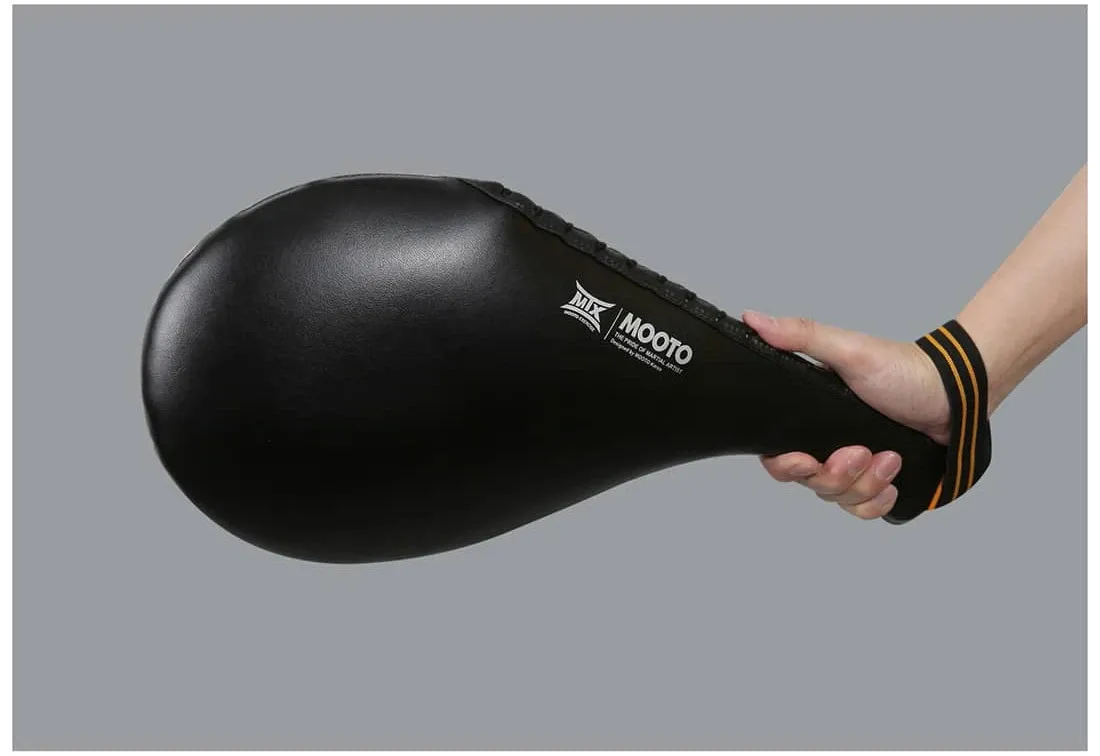
MTX Target Mitt Single/Double
适合各种打击和踢腿训练。
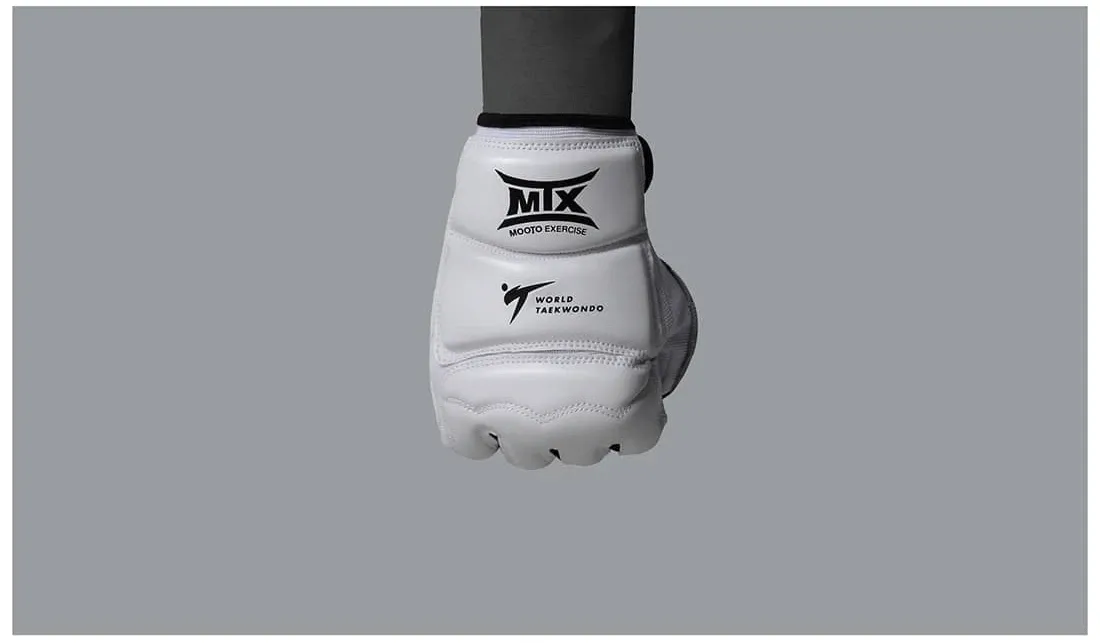
MTX 2 Hand Protector
MTX 是为全球所有跆拳道运动员的基础训练及比赛提升而设计的系列。不仅品质优良,还承诺合理价格,使每位跆拳道运动员都能无负担地佩戴使用。
KEY TAKEAWAYS
- →Tier the list: linear kicks and basic blocks stay in the core; spinning and high kicks move to conditioning only.
- →Distance first: recovering distance outranks countering, and reacting before threshold distance breaks is the whole skill.
- →Close range: chin tucked, shoulders raised, forearms and hand protectors forming a plane; fit comes before anything else when buying guards.
- →Programme it: two sessions a week in four parts, with the pressure scenario block as the core of the class.